
Does Solar Work in Pittsburgh?
Solar works in Greater Pittsburgh despite cloud cover. See how weather, snow, and roof orientation affect rooftop panel output in Western Pennsylvania.
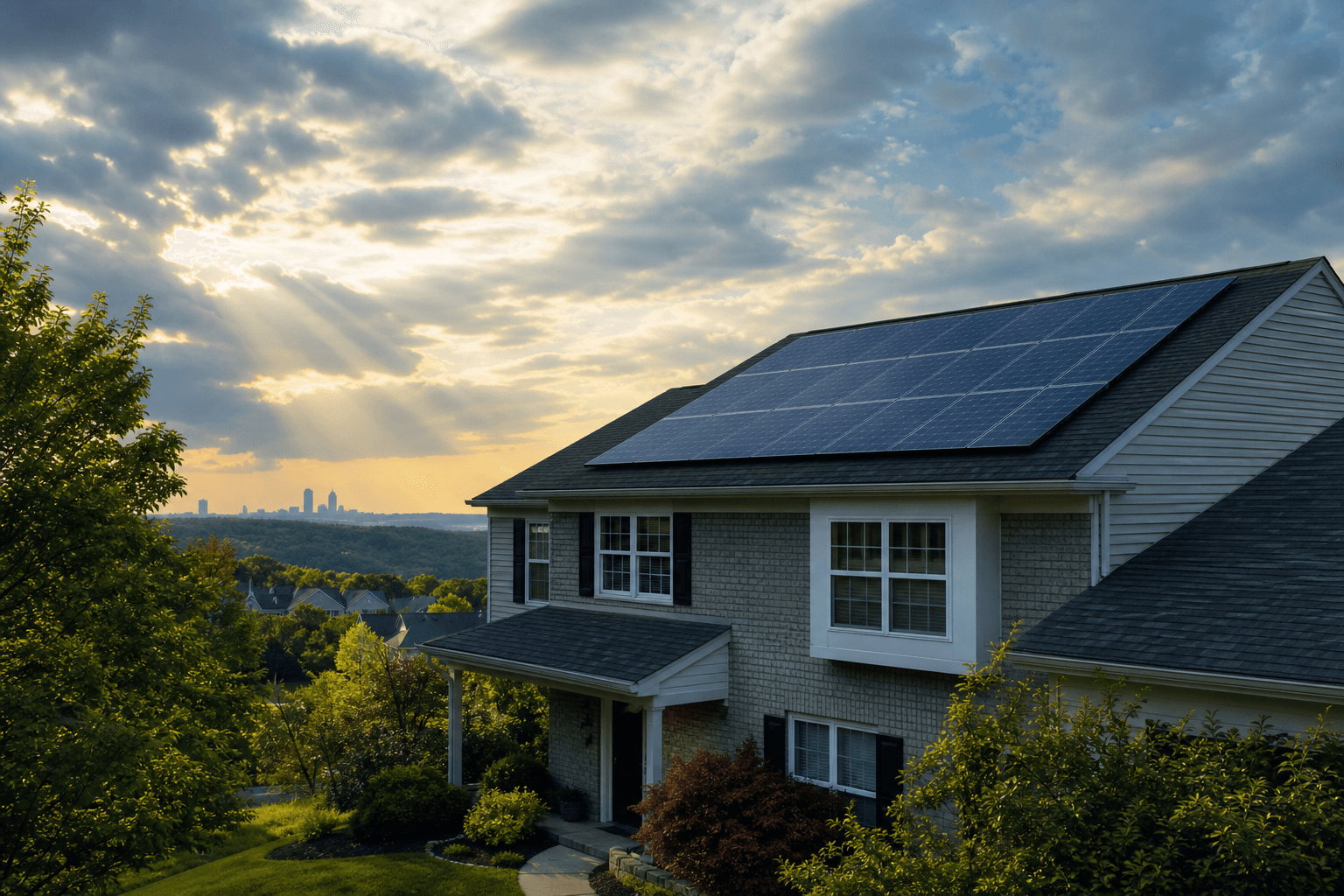
"Pittsburgh is too cloudy for solar" is one of the most common objections Western Pennsylvania homeowners raise, and it is mostly a myth. Solar panels produce electricity from light, not just direct desert sunshine. Cloudy days reduce output compared to clear ones, but they do not zero it out.
The better question is not whether solar works at all, but how much energy your specific roof will produce compared to your usage, and whether that production justifies the investment after incentives.
What the data shows for Pittsburgh
The Greater Pittsburgh region receives roughly 4 to 4.5 peak sun hours per day on average across the year. That is less than Arizona, but enough for widely deployed residential systems. NREL and industry tools (such as PVWatts) use local weather files to estimate production by ZIP code and roof orientation.
Thousands of residential arrays operate in Allegheny County and surrounding counties. Their existence is practical proof that the climate supports solar, with realistic production expectations baked into payback math.
How panels behave on cloudy days
Photovoltaic cells respond to diffuse light when clouds scatter sunlight. Output might drop to 10 to 30% of a clear-sky peak on heavy overcast days, or higher on bright overcast days. Your system still generates; you draw more from the grid those days.
Over a full year, seasonal variation matters more for budgeting than any single rainy week:
- Longer summer days boost summer production
- Shorter winter days reduce December and January output
- Snow can cover panels briefly; most arrays are angled so snow slides off after melt
Net metering helps balance seasonal swings by crediting excess summer production against winter imports (how net metering works).
Snow and ice in western PA
Pittsburgh winters bring snow. Effects include:
- Temporary coverage blocking production until panels clear
- Cold weather performance: ironically, panels can be slightly more efficient when cold; the issue is shorter days and snow cover, not temperature alone
Installers often set tilt so snow sheds. Avoid trying to scrape panels yourself. Risk of damage and warranty issues.
Modeling software typically includes regional snow loss factors. Ask to see winter month estimates in your proposal, not just annual totals.
Roof orientation in Pittsburgh latitudes
At roughly 40°N latitude, south-facing roofs at a moderate pitch often maximize annual kWh. East/west roofs can work:
- East: more morning production
- West: more afternoon production, sometimes aligning with post-work usage
Flat roofs use tilt racks. North-facing slopes are usually poor candidates unless mounting geometry compensates (uncommon on residential pitched roofs).
A site-specific shading analysis matters more than city-wide averages. Two homes on the same street can differ dramatically because of trees or building shadows.
Comparing Pittsburgh to "solar city" headlines
National ads citing Florida or California production can mislead Pittsburgh buyers. When evaluating quotes:
- Insist on Pittsburgh-area weather data in the production report
- Compare kWh/year estimates across installers for the same roof plane
- Divide estimated production by system kW to sanity-check (typical regional yields often fall in a recognizable band for your orientation)
If one proposal shows 30% more production than another for the same array size and roof, ask why.
Cloud cover and payback
Lower annual production than a sunnier city means more kW may be needed to hit the same offset, or you accept a lower offset percentage. Payback stretches if production is overstated.
Conservative modeling protects you. Use the low end of reasonable production ranges when mentally calculating savings until you have actual production data from a similar nearby system.
Other local factors beyond clouds
Climate is one piece. Also consider:
- Tree growth over 25 years: will shading worsen?
- Utility rate trends: affect savings more than an extra sunny week
- Roof condition: leaks or aging shingles undermine any production benefit
Our Pittsburgh residential solar guide covers roof readiness and timeline.
When climate is not the limiting factor
Sometimes cloud cover is a red herring. The real blockers are:
- Heavy permanent shading
- Roof too small for meaningful kW
- Very low electricity use
- Planned move within a few years
In those cases, poor economics may have little to do with Pittsburgh weather.
Bottom line for homeowners
Solar does work in Pittsburgh's climate when the roof is suitable and production is modeled honestly. Cloudy skies reduce peak output but do not eliminate viability. Focus on site-specific production estimates, seasonal billing patterns with net metering, and comparison of installer assumptions.
For costs tied to local production, see solar panel costs in Pittsburgh. For SRECs, net metering, and other programs that affect payback, see Pennsylvania solar incentives (2026 overview).
Have questions about your roof or neighborhood? Contact us with your ZIP code. Informational only, no installer affiliation.
Related posts
How residential solar works in Greater Pittsburgh and Western PA: roof fit, production, costs, and steps to evaluate a system before you talk to an installer.
How Pennsylvania net metering credits your solar exports: utility rules, billing impacts, and what to ask before interconnecting a rooftop system in Western PA.
Typical solar costs for Greater Pittsburgh homes: price per watt, system sizes, what drives quotes, and how to compare proposals without sales pressure.