
Solar Panel Cost in Pittsburgh
Typical solar costs for Greater Pittsburgh homes: price per watt, system sizes, what drives quotes, and how to compare proposals without sales pressure.
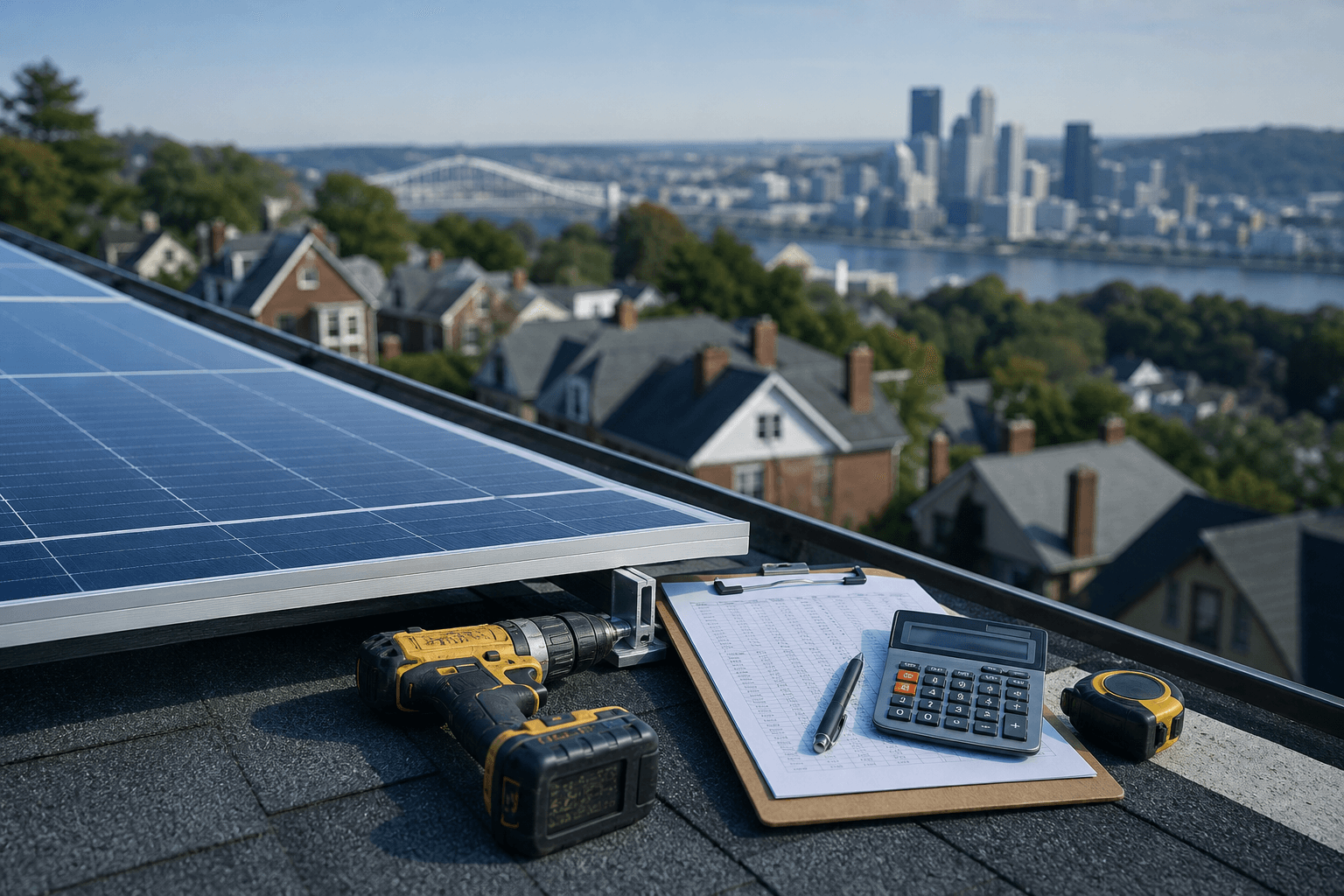
"How much does solar cost?" is the first question most Greater Pittsburgh homeowners ask, and the honest answer is: it depends, usually on system size, equipment, roof complexity, and who installs it.
This guide explains how pricing works so you can compare proposals intelligently. We are not quoting live market prices (they change); we are explaining the structure behind the numbers you will see.
How solar is priced
Installers typically quote a total installed price for a turnkey system. Internally, that breaks down to:
- Solar panels (modules)
- Inverter(s) or microinverters
- Racking and mounting hardware
- Electrical work, disconnects, and monitoring
- Labor, permits, and interconnection fees
- Overhead and margin
A common industry shorthand is price per watt: total cost divided by system size in watts. An 8 kW (8,000 watt) system quoted at $21,600 is $2.70/watt before any programs or credits.
Comparing $/watt across proposals of similar equipment tier helps spot outliers, but only when scope is equivalent (same panel tier, inverter type, warranty, roof work included or excluded).
Typical $/watt range in Greater Pittsburgh (2026)
Based on typical market snapshots, Greater Pittsburgh residential quotes often fall between $2.60 and $2.75 per watt installed for standard rooftop systems. That is a typical range, not a live quote or guarantee:
| System size | At $2.60/W | At $2.75/W | |-------------|------------|------------| | 6 kW | ~$15,600 | ~$16,500 | | 8 kW | ~$20,800 | ~$22,000 | | 10 kW | ~$26,000 | ~$27,500 |
Premium equipment, batteries, difficult roofs, or panel upgrades can push $/watt higher. Very small systems sometimes show higher $/watt because fixed costs spread over fewer watts.
Always request itemized proposals from licensed installers serving Allegheny County and your utility territory.
Typical system sizes for Pittsburgh homes
Residential systems in the Greater Pittsburgh area often fall between 6 kW and 12 kW DC, depending on:
- Annual electricity consumption (kWh)
- Available unshaded roof area
- Goals (offset 80% vs 100% of usage)
A home using ~10,000 kWh per year might need a larger array than one using 6,000 kWh. Your utility bills are the starting point, not a neighbor's system size.
Use our Pittsburgh homeowner guide to gather usage data before requesting quotes.
What drives costs up
Several factors push quotes above a baseline $/watt:
Roof complexity
Steep pitch, multiple levels, skylights, dormers, and difficult access add labor time. Tile or slate roofs may need specialized mounting.
Electrical panel upgrades
Older 100-amp panels sometimes require upgrades to support solar backfeed safely. That line item should appear explicitly, not surprise you at installation.
Premium equipment
High-efficiency panels, battery storage, and premium inverters cost more. Batteries add thousands and change backup capabilities. Evaluate whether you need them beyond "solar sales bundle" packaging.
Tree work or roof replacement
If trimming or re-roofing is required, that is separate from the panel quote but affects total project cost.
Travel or small-system penalties
Very small arrays can have higher $/watt because fixed costs spread over fewer watts.
Federal tax credit and 2026 net cost
The residential federal tax credit (Section 25D) expired December 31, 2025 for owner-purchased systems. If you buy a system placed in service in 2026, plan on paying the full gross contract price unless other programs apply.
| Line item | Example (2026 purchase) | |-----------|-------------------------| | Gross price | $21,600 (8 kW at $2.70/W) | | Section 25D residential ITC | $0 for new owner-purchased systems | | Net upfront cost | $21,600 (before SRECs or utility rebates) |
Lease or PPA: you do not claim the credit; a third party may use Section 48E through 2027. Compare total cost over the contract term, not just monthly payment.
See Pennsylvania incentives overview for SRECs, net metering, and utility programs.
Payback and savings: use realistic assumptions
Payback is usually estimated as:
Net cost after programs ÷ annual utility savings
Annual savings depend on:
- kWh produced (site-specific model)
- Your retail electricity rate and rate structure
- Net metering credit rules (explained here)
- SREC income, if registered and sold
- Future rate changes (unknown)
Without the residential ITC, Greater Pittsburgh payback periods often land in the 10 to 18 year range in many market models, though yours may differ. Shorter payback often correlates with high usage, good roof conditions, competitive pricing, and strong net metering value.
Comparing three proposals the right way
When you receive quotes, align:
- System size (kW) and estimated annual production (kWh)
- Equipment brands and warranty lengths (25-year panel product vs 25-year performance)
- Inverter type (string vs micro) and monitoring included
- Roof work, permits, and interconnection: all included?
- $/watt on gross price (do not assume a 30% federal credit in 2026)
The lowest gross price is not always the best value if equipment is tier-3 or workmanship warranty is short.
Financing options affect true cost
- Cash: lowest total cost if you can deploy capital; no residential ITC to offset it in 2026
- Solar loan: compare APR, term, and whether a dealer fee is embedded in principal
- Lease/PPA: lower upfront, but you forfeit ownership and any personal credit; review escalators
Run the total paid over 20 years for each path, not just monthly payment.
Commercial intent vs education
Eventually you may request installer quotes. That is normal. While researching, focus on understanding what you are buying so sales conversations stay grounded. Questions to ask:
- "Show me the production model for my address."
- "What happens to my bill in January vs July with net metering?"
- "Is a main panel upgrade included? If not, what is the cost?"
- "Are you applying a federal residential tax credit to this quote? On what basis?"
When cost alone should not decide it
A cheap quote on a shaded roof or with unstated roof repairs can cost more long term. A slightly higher price from a licensed, insured contractor with strong workmanship warranty may be safer.
Solar may also not be economical for your home, and a good installer will tell you that.
Summary
Greater Pittsburgh solar costs are driven by system size, roof and electrical conditions, equipment choices, and installer pricing. Use $/watt for comparison (often $2.60 to $2.75/W as a typical band), verify what is in scope, and model payback without assuming a 2026 residential ITC on purchased systems.
For climate and production context, read does solar work in Pittsburgh's climate. For program details, see Pennsylvania incentives.
This site does not sell installations or provide live quotes. Verify all pricing with licensed professionals.
Related posts
How Pennsylvania net metering credits your solar exports: utility rules, billing impacts, and what to ask before interconnecting a rooftop system in Western PA.
Solar works in Greater Pittsburgh despite cloud cover. See how weather, snow, and roof orientation affect rooftop panel output in Western Pennsylvania.

What Pennsylvania homeowners should know about 2026 solar incentives: expired residential ITC, SRECs, net metering, utility programs, and lease or PPA credit rules.